Preparing for the Physics Quiz GCSE exam can feel overwhelming, given the wide array of topics and the importance of understanding both theory and practical applications. One of the most effective ways to reinforce learning and gauge your understanding is through a physics quiz GCSE. Quizzes provide an interactive way to test knowledge, identify weak areas, and build confidence before sitting for the actual exam. Unlike passive revision methods, quizzes encourage active recall, forcing the brain to retrieve information, which is proven to improve memory retention and comprehension.
The use of quizzes in physics revision is particularly effective because the subject combines theoretical concepts with practical applications. For example, understanding Newton’s laws, energy transformations, or the principles of electricity is only valuable if you can apply them in exam scenarios. Physics Quiz GCSE often include multiple question formats, such as multiple-choice, short-answer, calculation-based, and practical interpretation questions, making them versatile tools for comprehensive revision.
In addition, quizzes can be tailored to individual learning needs. You can focus on topics you struggle with while skipping areas you are confident about. This targeted practice saves time and ensures more effective revision. Using Physics Quiz GCSE regularly also helps students become familiar with the type of questions asked in the GCSE exams, reducing anxiety and improving time management during the actual test. By integrating quizzes into your study routine, you can approach your Physics exam with confidence, prepared for both theoretical questions and problem-solving challenges.
Core Topics Covered in a Physics Quiz GCSE
A well-rounded physics quiz GCSE covers all the essential topics outlined in the curriculum. One of the main areas is forces and motion, which explores concepts such as speed, acceleration, Newton’s laws, and momentum. Understanding these concepts is crucial for solving problems related to everyday scenarios, such as calculating the stopping distance of a car or the effect of balanced and unbalanced forces on objects.
Energy is another key topic, including kinetic energy, potential energy, work, and power. Students must understand how energy is stored, transferred, and conserved in various systems. Questions often require calculations or explanations of energy changes in real-world contexts, such as in roller coasters, engines, or electricity generation.
Electricity forms a significant part of the physics curriculum. A typical quiz will cover circuits, current, voltage, resistance, and the use of series and parallel circuits. Understanding electrical principles is essential for both theoretical questions and practical experiments, such as using ammeters and voltmeters to measure electrical properties accurately.
Other important topics include waves, covering light and sound properties, reflection, refraction, and wave behavior, magnetism and electromagnetism, exploring magnetic fields, forces, and applications in motors and generators, and atomic structure and radioactivity, which examines subatomic particles, isotopes, and radiation. Covering all these areas in quizzes ensures students develop a deep and comprehensive understanding of GCSE Physics.
Types of Questions in Physics Quiz GCSE
Multiple-choice questions are one of the most common formats in Physics Quiz GCSE. They test knowledge of key concepts quickly and can highlight misconceptions or areas of uncertainty. The challenge lies in carefully analyzing each option and avoiding common traps, such as answers that are partially correct but misleading.
Short answer questions require concise, accurate explanations or definitions. These questions test your understanding of concepts beyond rote memorization. For example, you might be asked to explain the difference between mass and weight, or describe energy transfers in a system. Practicing these ensures clarity in expressing scientific ideas.
Calculation and problem-solving questions form a significant portion of quizzes. Students are expected to apply formulas for motion, energy, and electricity. Step-by-step reasoning is essential, as examiners assess both the correct answer and the method used. Regular practice in calculations builds speed, accuracy, and confidence under timed conditions.
Practical-based questions involve interpreting experiment results, graphs, or data tables. These assess your ability to apply theoretical knowledge in practical scenarios. Understanding how to draw conclusions from data, evaluate experimental errors, and suggest improvements is essential for success in both quizzes and exams. Combining all these question types ensures comprehensive preparation and develops the problem-solving skills required for GCSE Physics.
How to Prepare for a Physics Quiz GCSE
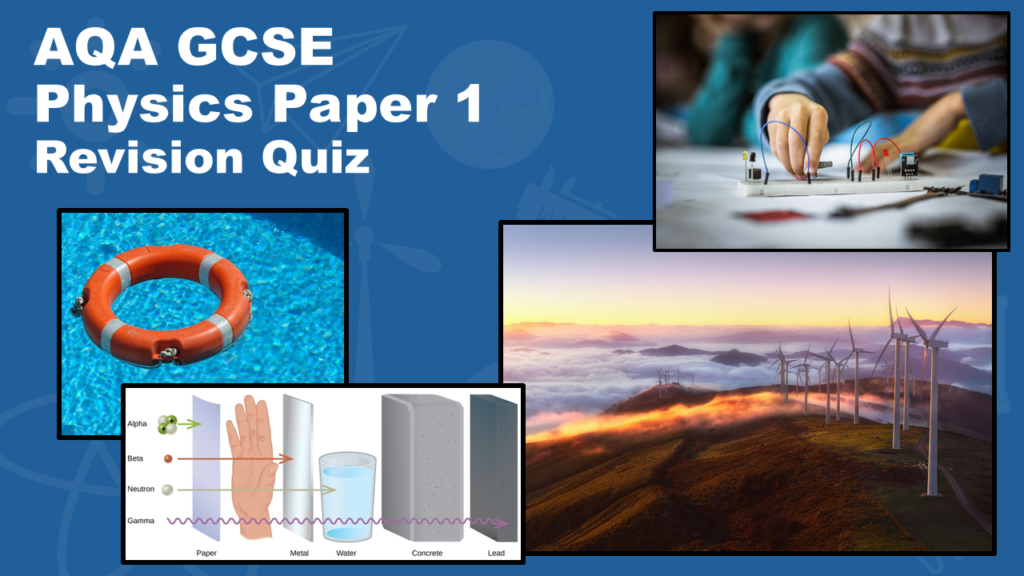
Effective preparation for a physics quiz GCSE requires a structured approach. Active revision techniques such as spaced repetition, flashcards, and mind maps are proven to improve memory retention. Revisiting topics at regular intervals ensures that knowledge is reinforced over time, rather than crammed at the last minute. Mind maps help organize complex concepts visually, making it easier to understand relationships between topics like energy, forces, and waves.
Using past papers and online quizzes is another effective strategy. These resources provide a realistic sense of question format, difficulty level, and timing. Attempting quizzes under exam conditions enhances focus and helps develop time management skills. Tracking performance across multiple quizzes allows students to identify weak areas and prioritize them for further study.
Time management is essential when taking quizzes. Breaking down revision sessions into focused intervals, such as 30-45 minutes per topic, helps maintain concentration and avoids burnout. After completing quizzes, reviewing incorrect answers and understanding the reasoning behind mistakes ensures continuous improvement.
Finally, combining quizzes with traditional revision techniques, such as reading textbooks, summarizing key points, and practicing problem-solving, results in a well-rounded study plan. Consistent, strategic preparation ensures that students are ready to tackle any question type in the GCSE Physics exam.
Benefits of Taking a Physics Quiz GCSE
Taking Physics Quiz GCSE offers multiple advantages. First, it reinforces theoretical knowledge by requiring active recall. Instead of passively reading notes, students must retrieve information and apply it, which strengthens understanding and memory. This active engagement ensures that concepts like energy transfer, electricity, or motion are firmly retained.
Second, quizzes help build confidence. Familiarity with question formats and practice under timed conditions reduces exam anxiety. When students encounter similar questions in the actual exam, they can approach them with clarity and composure.
Quizzes also highlight areas that need improvement. By identifying weak topics, such as magnetism or radioactivity, students can focus their revision efficiently. Additionally, quizzes improve problem-solving skills by simulating the challenges of applying theoretical knowledge to calculations, practical scenarios, and data interpretation.
Finally, quizzes offer a measurable way to track progress. Scores, completion times, and areas of difficulty provide feedback on learning, helping students set achievable goals and monitor improvement over time. These benefits make physics quizzes an essential tool for any GCSE student aiming for high marks.
Recommended Resources for Physics Quiz GCSE
Several resources can enhance quiz-based revision. Textbooks and revision guides remain foundational, providing explanations, examples, and practice questions aligned with the GCSE syllabus. Worksheets offer additional exercises to reinforce learning.
Online quizzes and interactive platforms allow students to practice anytime and receive instant feedback. Platforms such as BBC Bitesize, Physics & Maths Tutor, and other educational websites provide structured quizzes covering all key topics.
YouTube tutorials and educational videos offer visual explanations of complex concepts, from electromagnetic fields to energy calculations. Watching experiments and simulations helps consolidate theoretical understanding.
Lastly, study groups and peer discussions can reinforce learning. Discussing quiz questions with classmates allows students to explain concepts aloud, clarify doubts, and gain new perspectives. Combining these resources with regular quiz practice ensures comprehensive preparation.
Conclusion
A physics quiz GCSE is an invaluable tool for students aiming to excel in their exams. It reinforces knowledge, builds confidence, and improves problem-solving and practical skills. By practicing a variety of question types, focusing on core topics, and using structured revision strategies, students can approach the exam well-prepared and confident.
Regular quiz practice, combined with resources such as textbooks, online platforms, and peer discussions, ensures that learning is active, targeted, and effective. With dedication and strategic preparation, students can maximize their performance, achieve high marks, and develop a strong foundation in physics that will benefit future studies.
Frequently Asked Questions (FAQs)
What is a physics quiz GCSE?
A physics quiz GCSE is a set of questions designed to test knowledge and understanding of topics covered in the GCSE Physics curriculum, including theory, calculations, and practical applications.
How often should I take a physics quiz for effective revision?
Ideally, students should take quizzes regularly, such as once or twice a week, and more frequently as exams approach, to reinforce learning and identify weak areas.
Are online quizzes reliable for GCSE exam preparation?
Yes, online quizzes from trusted educational platforms follow the GCSE syllabus and provide instant feedback, making them reliable for practice.
How can I improve my score in physics quizzes?
Review incorrect answers, practice calculation-based questions, and revise weak topics regularly to improve quiz performance.
What topics should I focus on the most in a physics quiz?
Focus on areas you find challenging, but ensure all core topics, including forces, energy, electricity, waves, magnetism, and atomic structure, are covered.
Can quizzes replace traditional revision methods?
Quizzes are a powerful supplement but should be combined with textbooks, past papers, and practical exercises for comprehensive preparation.
Are there free resources available for physics quiz GCSE practice?
Yes, platforms like BBC Bitesize, Physics & Maths Tutor, and various educational apps offer free quizzes aligned with the GCSE curriculum.
You May Also Read: Derry Parade Today