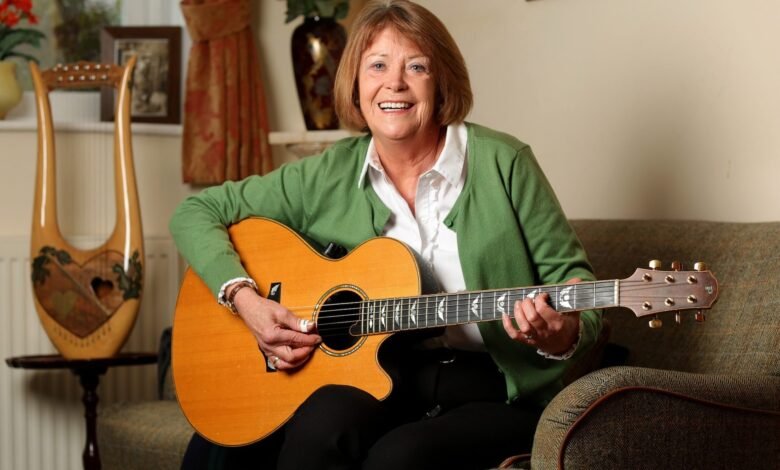
Isla St Clair (born Isabella Margaret Dyce on 2 May 1952) is a Scottish folk singer and television presenter who became a household name as Larry Grayson’s co-host on BBC One’s The Generation Game between 1978 and 1982.
Hers was an unusual route to Saturday-night television: a child performer raised inside Scotland’s traditional music world, singing material learned at her mother’s folk club, who crossed into light entertainment without diluting the tradition that made her.
This article tells that story — the North East childhood, the folk-club apprenticeship, the Generation Game years, her award-winning series The Song and the Story, and the later career of recordings, documentaries and commemorative performances.
Early Life and Musical Roots
St Clair was born in Grangemouth, in Central Scotland, on 2 May 1952. Her family came from the North East of Scotland, and it was in Findochty, on the Moray coast, that she first performed on stage — aged three, at her mother’s Brownie concerts and with the local Salvation Army.
The family moved to Bradfield Green, near Crewe in Cheshire, in 1955 and returned to Scotland in 1960. Her mother, Zetta Sinclair, was a songwriter and poet and a founding member of the Aberdeen Folk Club; Isla sang alongside her at the club and came to the attention of a BBC producer.
She was a pupil at Aberdeen Academy and, from 1967, at Buckie High School, singing at the opening night of the Buckie and District Folk-Song Club, which her mother ran. At twelve she sang on her first television programme, Talk of the North, and on the radio series Stories are for Singing. When her mother remarried in 1968, Isla adopted the original form of her mother’s maiden name — St Clair.
Rise to Fame in Folk Music
In 1969 she moved to Edinburgh to pursue singing professionally. Her teenage influences were formidable: Jeannie Robertson, the great traditional ballad singer and a friend of her mother’s, and Hamish Henderson of the University of Edinburgh’s School of Scottish Studies, who had first recorded her when she was twelve.
Her first LP, Isla St Clair Sings Traditional Scottish Songs, appeared in 1971, and the New Musical Express voted her its Female Folk Singer of the Year — recognition that she was a leading young voice of the British folk revival.
Through the 1970s she worked constantly: her own series Isla’s Island, which ran to 34 programmes, and Welcome to the Ceilidh; appearances on shows such as Thingummyjig and The Great Western Musical Thunderbox; and concert tours of the British Isles, continental Europe, the United States and the Soviet Union, which she toured twice.
Television Career and Mainstream Success
The crossover began almost by accident: in the late 1970s she went to STV asking for a job as a continuity announcer, and was instead given a co-presenting job, alongside Peggy O’Keefe, on a series called Birthday Honours.
National fame arrived in 1978, when she became co-host with Larry Grayson on the BBC’s The Generation Game. During her four years on the programme she won the Pye Colour Television Award for TV Personality of the Year, and appeared on the Morecambe and Wise show, Parkinson, Blue Peter, Blankety Blank and the Royal Variety Performance, alongside her own BBC children’s series, The Farm on the Hill.
In 1981 the BBC gave her a series of her own: The Song and the Story, in which she appeared in period costume and explained the social history behind folk songs. It won the Roses Award for Best Television Programme and the Prix Jeunesse in Munich for Best Light Entertainment. She went on to co-present The Travel Show with Des Lynam for BBC Two and Central Television’s The Saturday Show with Tommy Boyd.
Career Highlights and Achievements
Her honours span both her worlds: the New Musical Express’s Female Folk Singer of the Year as a teenager; TV Personality of the Year during her Generation Game period; and two major awards for The Song and the Story, the programme that fused her musical and television careers into a single format.
In 2002 the University of Aberdeen awarded her an honorary degree — Master of the University — for her lifelong contribution to the traditional music of Scotland, a form of recognition few light-entertainment presenters ever receive.
Her later recording career includes Inheritance (1993) and Scenes of Scotland (1996), a collection of her mother’s songs. In 1998 she co-produced and appeared in When the Pipers Play, a documentary about the Highland bagpipe that premiered on PBS in the United States and won four film festival awards.
Personal Life and Public Image
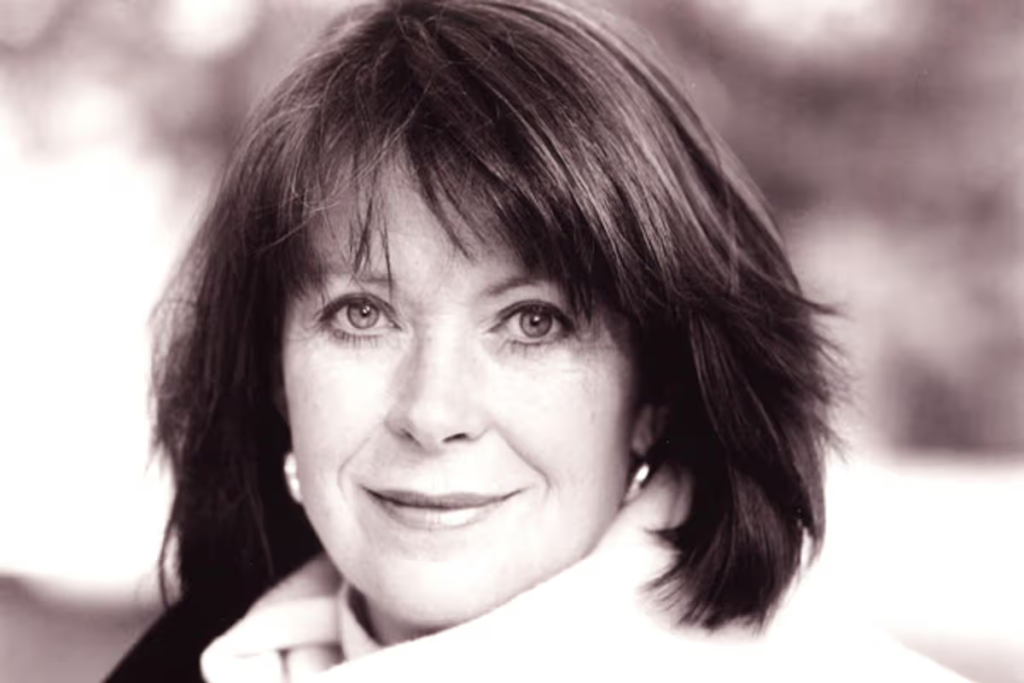
St Clair’s career contains one deliberate interruption: in 1984, having been offered the role of Maria in The Sound of Music at Worthing, she chose instead to step back from the business for a while in order to bring up her young family.
She has kept her family life largely out of the press, before and since. The public record of her life is overwhelmingly a record of work: songs sung, programmes presented, albums released.
Her family connection to the music is part of the public story, though: her mother Zetta wrote songs that Isla performed decades later, including ‘Dunkirk – Lest We Forget’, which she sang at the Festival of Remembrance at the Royal Albert Hall in 2000.
Legacy and Cultural Impact
St Clair’s cultural significance lies in the bridge she built: a genuine traditional singer — recorded at twelve by the School of Scottish Studies — who carried folk song, quite unembarrassed, into the biggest light-entertainment formats in Britain.
She also became a singer for national moments of remembrance: in 2007 she sang the lament ‘Flowers of the Forest’ at Tyne Cot Cemetery in Belgium for the 90th anniversary of the Battle of Passchendaele, and she recorded it again in 2011 for the Scots Guards album From Helmand to Horse Guards.
Her wartime-songs stage production, Eyes Front!, toured in 2011–2013, and she was still appearing at folk clubs in 2018 — a performing life that stretches from a Findochty stage in 1955 into the present century.
Conclusion
Isla St Clair’s career is the story of a tradition carried intact into the mainstream: learned at a folk club from her mother, proved on television’s biggest stage, and returned in later years to the songs and commemorations it came from.
Few British performers can claim both a peak-time Saturday-night institution and an honorary degree for services to traditional music. St Clair can — and that combination is her legacy.
FAQs
Who is Isla St Clair?Isla St Clair (born Isabella Margaret Dyce in Grangemouth on 2 May 1952) is a Scottish folk singer and television presenter, best known as Larry Grayson’s co-host on The Generation Game from 1978 to 1982.
What is she famous for?For co-hosting The Generation Game with Larry Grayson (1978–1982), for her own BBC series The Song and the Story (1981), and for a recording career in traditional Scottish song that began when she was a child.
What type of music did she perform?Traditional Scottish and British folk music, especially the ballads of the North East — the repertoire she learned from her mother and from singers such as Jeannie Robertson.
Was Isla St Clair on television?Yes — extensively. Beyond The Generation Game, she presented or appeared on Isla’s Island, Welcome to the Ceilidh, The Farm on the Hill, The Travel Show, The Saturday Show and Songs of Praise, among many others.
Is Isla St Clair still active?She stepped back from full-time show business in the 1980s to raise her family, returned with albums and documentaries in the 1990s and 2000s, toured her stage show Eyes Front! in 2011–2013, and was still appearing at folk clubs in 2018.
Why is she important?Because she carried authentic traditional singing into mainstream British television at its most popular — and was honoured for it, receiving an honorary degree from the University of Aberdeen in 2002 for her lifelong contribution to Scotland’s traditional music.
You May Also Read: Archie Jay Lomas