
The word pedantic is often used to describe someone who pays extreme attention to small details, rules, or technical accuracy. While knowledge and precision are generally positive qualities, a pedantic approach can sometimes make communication difficult. People may use the term when someone focuses more on correcting minor mistakes than on understanding the overall message. As a result, the word has become a common part of discussions about communication styles and personality traits.
Understanding what pedantic means is important because this behavior appears in many areas of life. From classrooms and workplaces to social media platforms and personal relationships, people frequently encounter individuals who value exactness above all else. This article explores the meaning of pedantic, its origins, characteristics, advantages, disadvantages, and its impact on everyday interactions. By gaining a deeper understanding of pedantic behavior, readers can improve communication and build stronger relationships.
What Does Pedantic Mean?
The term pedantic refers to a person who is excessively concerned with formal rules, precise details, and technical correctness. Instead of focusing on the main idea of a conversation, a pedantic individual may pay attention to small inaccuracies, grammar mistakes, or minor factual errors. This behavior often makes discussions more focused on details than on the broader message being communicated.
In everyday language, a pedantic person is someone who constantly corrects others or insists on perfect accuracy. For example, if someone shares an interesting story but accidentally mentions the wrong year, a pedantic listener may interrupt to correct the date rather than engaging with the story itself. Although accuracy has value, too much focus on trivial details can create frustration and distract from meaningful communication.
The concept of being pedantic is not always negative. In professions that require precision, such as engineering, law, medicine, and scientific research, attention to detail is essential. However, the challenge lies in recognizing when accuracy genuinely matters and when it becomes unnecessary. Understanding the balance between correctness and practicality is key to avoiding overly pedantic behavior.
The History and Etymology of Pedantic
The word pedantic has an interesting history that dates back several centuries. It originates from the Italian word pedante, which originally referred to a teacher or schoolmaster. During earlier periods, educators were associated with strict learning methods, detailed instruction, and careful attention to academic rules. Over time, the term evolved and became connected to individuals who displayed knowledge in an overly formal or rigid manner.
As language and society changed, the meaning of pedantic gradually shifted. Writers and philosophers began using the word to describe people who emphasized scholarly details while ignoring practical wisdom. Literature often portrayed pedantic characters as individuals who loved showing off their knowledge but struggled to connect with others in meaningful ways.
Today, the modern definition of pedantic reflects this historical transformation. While expertise and education remain respected, excessive focus on insignificant details is often viewed negatively. The evolution of the word highlights society’s preference for practical communication over unnecessary complexity. Understanding this history helps explain why the term carries both intellectual and critical associations.
Common Characteristics of a Pedantic Person
A pedantic person typically displays several recognizable characteristics. One of the most common traits is a strong focus on precision and accuracy. Such individuals often notice mistakes that others overlook and feel compelled to point them out. Whether the issue involves grammar, pronunciation, historical facts, or technical terminology, a pedantic individual usually wants everything to be exactly correct.
Another characteristic of pedantic behavior is the tendency to prioritize rules over context. Instead of considering the overall purpose of a conversation, a person may become fixated on small details. For example, they might interrupt a discussion to correct a minor spelling mistake or challenge a slight factual inaccuracy even when the correction adds little value to the main topic.
People with pedantic traits often enjoy sharing detailed explanations. They may provide extensive information about subjects they know well, sometimes offering more detail than the audience needs. While this can demonstrate expertise, it can also overwhelm listeners and make communication less effective. Recognizing these characteristics can help individuals identify and manage pedantic tendencies in themselves and others.
Examples of Pedantic Behavior
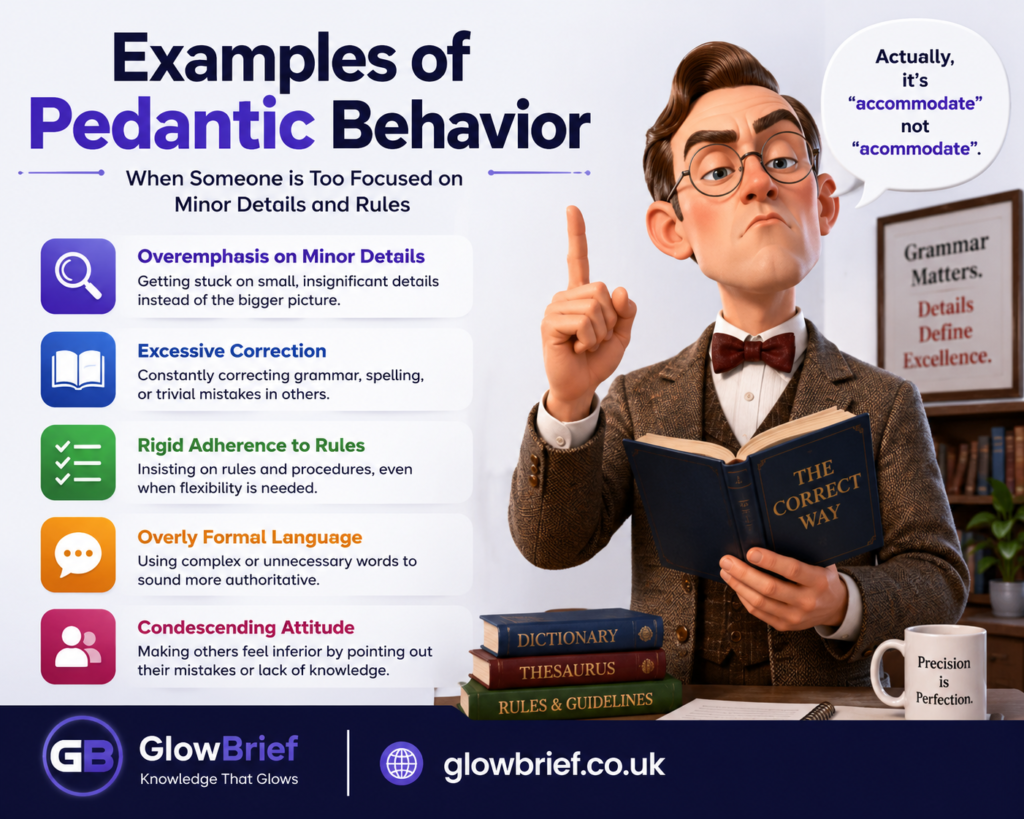
Examples of pedantic behavior can be found in many everyday situations. In casual conversations, a person might interrupt to correct a small grammatical mistake rather than responding to the actual point being made. Although the correction may be technically accurate, it often shifts attention away from the broader discussion.
The workplace also provides numerous examples of pedantic behavior. An employee might spend excessive time correcting formatting details in a report while overlooking more important strategic concerns. While attention to detail can improve quality, an overly pedantic approach may slow productivity and create unnecessary obstacles for team members.
Educational settings often highlight pedantic tendencies as well. Students or teachers may focus heavily on exact definitions, formal terminology, or specific wording. This dedication to precision can support learning, but it can also discourage creative thinking when taken too far. Online discussions provide another common example, as users frequently correct spelling, punctuation, or technical details instead of engaging with the central argument.
Advantages and Disadvantages of Being Pedantic
Being pedantic offers several advantages, particularly in fields where accuracy is critical. Individuals who pay close attention to details often produce high-quality work and identify mistakes before they become significant problems. In professions such as medicine, accounting, engineering, and law, a pedantic mindset can help maintain standards and reduce costly errors.
Another benefit of being pedantic is strong knowledge retention. People who value accuracy often remember facts, procedures, and technical information exceptionally well. Their careful approach can make them reliable sources of information and valuable contributors to professional environments. Organizations frequently depend on detail-oriented individuals to ensure consistency and compliance.
Despite these strengths, being pedantic also has disadvantages. Constant corrections and excessive focus on details can create tension in relationships. Friends, family members, and colleagues may perceive a pedantic person as critical or difficult to communicate with. In some cases, focusing too heavily on small issues can prevent progress toward larger goals.
Finding the right balance is essential. Accuracy and precision are valuable qualities, but they should not come at the expense of effective communication, collaboration, or creativity. A healthy approach combines attention to detail with flexibility and understanding.
How to Deal with a Pedantic Person
Interacting with a pedantic person can be challenging, but understanding their motivations often helps. Most individuals who display pedantic behavior are not trying to be difficult. Instead, they genuinely value accuracy and believe that correcting mistakes improves communication. Recognizing this intention can reduce frustration and encourage more productive interactions.
One effective strategy is to acknowledge valid corrections without allowing them to dominate the conversation. If a pedantic individual points out a minor error, it is often helpful to accept the correction and gently redirect the discussion toward the main topic. This approach maintains respect while preventing unnecessary distractions.
Patience and clear communication are also important. Setting respectful boundaries can help when corrections become excessive. By focusing on shared goals rather than minor disagreements, individuals can build stronger relationships and reduce the negative effects of pedantic behavior.
Conclusion
The term pedantic describes a person who places exceptional importance on details, rules, and technical accuracy. While this trait can contribute to expertise, precision, and reliability, it can also create communication challenges when taken to extremes. Understanding pedantic behavior allows individuals to appreciate the value of accuracy while recognizing the importance of flexibility and context.
Ultimately, the goal is balance. A healthy approach combines attention to detail with practical thinking and effective communication. By understanding the meaning and impact of pedantic tendencies, people can improve their interactions, strengthen relationships, and focus on what truly matters.
FAQs
What does pedantic mean?
Pedantic means being excessively concerned with details, rules, and technical correctness.
Is being pedantic a bad thing?
Not necessarily. Being pedantic can be beneficial in situations that require precision, but it may become problematic when it interferes with communication.
What is an example of pedantic behavior?
Correcting someone’s grammar during a casual conversation instead of responding to their main point is a common example.
How is a pedantic person different from a perfectionist?
A perfectionist seeks flawless outcomes, while a pedantic person focuses heavily on rules, details, and accuracy.
Can pedantic behavior help in the workplace?
Yes. Pedantic individuals often excel in roles that require careful attention to detail and error prevention.
Why do people find pedantic individuals annoying?
Some people find pedantic behavior frustrating because constant corrections can interrupt conversations and shift attention away from the main topic.
Is pedantic behavior linked to intelligence?
Not always. Intelligence and pedantic behavior are separate concepts, although knowledgeable people may sometimes appear pedantic.
How can someone avoid sounding pedantic?
Focus on the overall message, avoid unnecessary corrections, and consider whether a detail is truly important before mentioning it.
You May Also Read: Pedantic Meaning