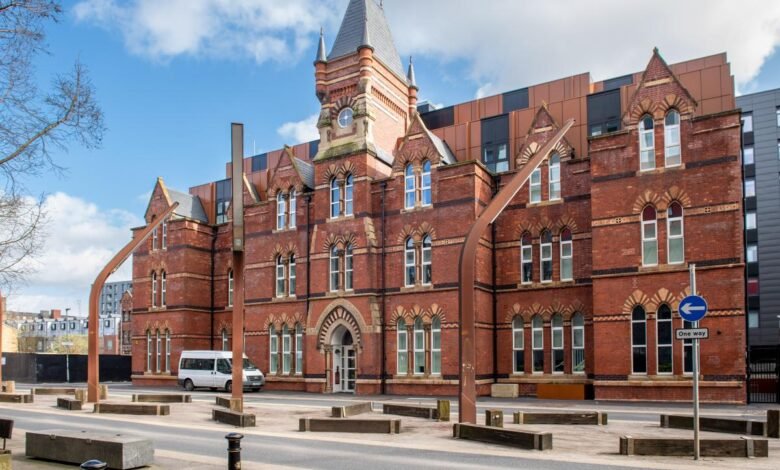
Ancoats Dispensary stands as one of Manchester’s most evocative relics of the city’s Victorian era — a symbol of industrial heritage, community healthcare, and determined conservation. Built in 1874, the dispensary served as a vital out‑patient healthcare centre providing treatment for the working poor of Ancoats and surrounding industrial neighbourhoods during a time of rapid urbanisation.
Although the wider Ancoats Hospital complex has long since disappeared, the Dispensary remains the only Grade II‑listed building of its kind in the area, reminding modern visitors of the social and economic history that shaped Manchester. Its recent sensitively executed redevelopment — transforming the site into affordable housing while preserving historic façades — has rekindled interest in its significance and ensured that its heritage continues to be visible in the fabric of the city.
This article explores the rich history, architectural significance, long period of decline, and remarkable restoration of the Ancoats Dispensary, offering readers a comprehensive understanding of why this landmark matters both culturally and socially in Manchester’s evolving urban landscape.
History of Ancoats Dispensary
The story of the Ancoats Dispensary begins in the early 19th century, when rapid industrial growth in Manchester created pressing healthcare needs for factory workers and their families. Before its eventual establishment on Mill Street, the Ardwick & Ancoats Dispensary operated from various earlier sites, providing vital out‑patient medical services for decades.
In 1874, the current brick building was constructed and formally opened, funded in part by philanthropist Miss Hannah Brackenbury and supported by worker contributions. Designed in a richly detailed Venetian Gothic Revival style, it included multiple floors of consulting rooms, waiting areas, and even space for inpatient care, reflecting not only its architectural ambition but its social mission.
For well over a century, the Dispensary played an essential role in Manchester’s healthcare landscape, offering affordable medical treatment at a time when access to formal hospital care was limited for many residents. However, after the broader Ancoats Hospital closed in 1989, the Dispensary fell into disrepair — a situation that sparked community activism and eventually led to initiatives aimed at preservation rather than demolition.
Its historical importance has been recognised through its Grade II listing — a designation that recognises buildings of special architectural and historic interest in the UK. This status helped protect it against neglect and potential destruction, ensuring that efforts to save and repurpose the building could be pursued.
Architecture and Design
Ancoats Dispensary is distinctive for its Victorian architectural character and craftsmanship. The building’s façade features red brick with decorative polychrome banding, steeply pitched slate roofs, and a central tower — elements typical of the Venetian Gothic Revival style popular in civic architecture of the period.
Unlike many industrial districts whose historic buildings have been lost to redevelopment, the Dispensary remains a rare survivor. Its design not only reflects the architectural trends of the late 19th century but also serves as a physical reminder of the era’s civic ambition to provide dignified public services in densely populated urban neighbourhoods.
Originally comprising multiple floors above a basement level, the building accommodated staff offices, waiting rooms, consultation spaces, and community areas. Its internal structure was arranged to support both administrative functions and patient care, making it a practical as well as aesthetically significant building.
While much of the interior was lost over years of neglect, particularly after the hospital’s closure, the external architectural fabric remained largely intact thanks to its listed status. Preservation efforts aimed to maintain these key design elements even as the building underwent transformation for new uses.
Restoration and Conservation Efforts

After decades of vacancy and deterioration, the Ancoats Dispensary was successfully foreseen for redevelopment through a £10 million restoration and conservation project. This initiative was a collaborative effort led by Great Places Housing Trust, Manchester City Council, the Greater Manchester Combined Authority (GMCA), Homes England, and construction partners like Eric Wright Construction.
The project focused on retaining as much of the original Grade II‑listed façade as possible, particularly those facing Old Mill Street and Lampwick Lane, and stabilising the structure to make it suitable for modern residential use. Sensitive new build work was carried out at the rear of the building, including a two‑storey extension that blends contemporary housing needs with historic preservation.
The outcome is a development of 39 affordable one‑ and two‑bedroom apartments, preserving key heritage features while creating much‑needed housing in the heart of Manchester. The restoration has been widely recognised for its architectural and cultural significance, earning the project a shortlist place at the AJ Retrofit Awards, which celebrate excellence in the adaptive reuse of historic buildings.
This achievement illustrates how historic preservation and modern urban development can work together to revitalise neglected assets and ensure that buildings with deep local significance continue to play a role in community life.
Cultural and Community Significance
Ancoats Dispensary’s significance goes beyond bricks and mortar — it embodies collective memory, healthcare history, and community identity. For generations of industrial workers and their families in Manchester, it was not only a place for medical treatment but a symbol of collective care and civic responsibility in an era before widespread government‑funded healthcare.
The building’s survival, amid widespread demolition of other hospital structures and historic sites in Ancoats, makes it a unique link to the area’s past. It is also featured in cultural references, including literature and artwork, most famously in a painting by Manchester artist L. S. Lowry, who depicted the hospital waiting hall in 1952.
Today, the restored Dispensary — now part of a larger wave of regeneration across Ancoats — contributes to residential life and heritage tourism, offering residents and visitors a tangible connection to Manchester’s Victorian roots. Its preservation underscores the value of community‑driven heritage campaigns and the importance of protecting historic buildings from complete loss, a concern raised by civic groups in earlier decades when demolition was proposed.
The adaptive reuse of the building as affordable housing also reflects contemporary priorities: balancing historical integrity with social needs such as housing affordability and inclusive urban living.
Conclusion
Ancoats Dispensary stands as a powerful example of how historic preservation can be thoughtfully integrated into modern city life. Originally built in 1874 to provide healthcare to Manchester’s burgeoning industrial population, it survived decades of neglect and the demolition of surrounding structures to emerge as a restored landmark with renewed purpose.
The careful conservation of its architectural features, combined with its transformation into affordable residences, illustrates a sustainable approach to heritage that honours the past while serving present‑day community needs. As part of Ancoats’ broader regeneration, the Dispensary now plays a vibrant role in both local identity and urban living.
From its origins as a beacon of Victorian social care to its rebirth as a residential landmark, the Ancoats Dispensary underscores the value of heritage‑led regeneration and the enduring importance of preserving sites that hold cultural and historical memory.
Frequently Asked Questions (FAQs)
What is the Ancoats Dispensary and why is it important?
The Ancoats Dispensary is a Grade II‑listed historic building in Manchester, originally built in 1874 to provide healthcare services to industrial workers and their families. Its significance lies in its architectural heritage and role in local social history.
When was the Ancoats Dispensary built?
The current building was constructed and opened in 1874, although earlier dispensary services existed in the area as far back as 1828.
Who designed the Ancoats Dispensary?
While the initial dispensary history involves multiple sites, the Mill Street building was part of a Victorian design informed by Gothic Revival architectural trends, with red brick and decorative elements typical of the period.
What was the original purpose of the dispensary?
It served as a medical centre providing affordable out‑patient healthcare to people who could not access or afford other facilities, relieving pressure on the wider Ancoats Hospital system.
Is Ancoats Dispensary open to the public today?
The restored building no longer functions as a healthcare facility; it has been converted into affordable housing units as part of a wider regeneration project.
How has the building been restored or preserved?
A £10 million conservation project protected key historic façades while building new residential space behind them, preserving both heritage and function.
Why is Ancoats Dispensary considered a heritage site?
Its Grade II listing recognises its architectural and historical value as one of the few remaining Victorian healthcare buildings in the region.
You May Also Read: Dingley Northamptonshire