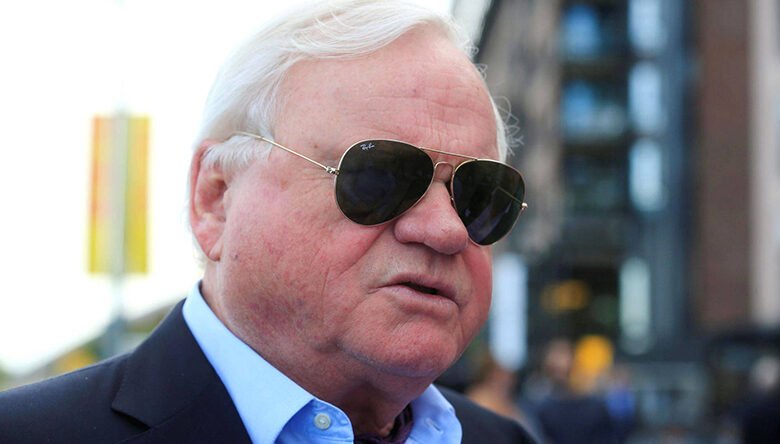
John Fredriksen (born 11 May 1944) is a Norwegian-born, Cypriot shipping and offshore billionaire who owns the world’s largest oil tanker fleet through Frontline plc, the company he chairs, with major interests in the offshore drilling contractor Seadrill and in Mowi, the world’s largest salmon producer.
Forbes put his net worth at US$17 billion in 2025; Norway’s Kapital magazine, which values his private assets more fully, put it at about US$27 billion (NOK 262 billion) in the same year. Either way, he is one of the richest men ever to come out of Norwegian shipping.
This article replaces the usual generalities with the documented record: a welder’s son from Vålerenga who started as a shipbroker’s messenger, made a fortune running tankers through the Iran–Iraq War, survived arrest and near-collapse in the 1980s, and built an empire held through his Cyprus-based companies Hemen Holding and Geveran Trading.
Early Life and Background
Fredriksen was born in Eidsvoll, Norway, on 11 May 1944 — not in Oslo, as many profiles state. His father, Gunnar, was a welder with the Norwegian State Railways, and his mother, Herdis, managed a canteen. The family moved to Oslo when he was three, and he grew up in Vålerenga, a working-class district in the east of the city.
He did not attend university. In 1961 he started at the bottom of the shipping industry, as a messenger at the Oslo shipbroker Blehr & Tenvig, studying for a commercial diploma at evening school while he worked.
The apprenticeship was international: tank broker at A. O. Andersen in Oslo by 1966, then out to Singapore with Wallem & Co., where he rose to chief of the firm, before returning to Oslo in 1969 as a tank broker with Anco. In Singapore the shipowner Jan Petter Røed taught him a lesson he never forgot — that money could also be made operating older tonnage, not just new ships.
Career Journey and Rise to Prominence
He set up his first company, the Liberia-registered Northern Tankers, in 1971, made a first fortune from long-term charters fixed around the Yom Kippur War — worth some US$40 million when prices rebounded — and founded the broker Northern Shipping in 1975, in lucrative partnership with Arab oil interests. In 1978 he left Norway for London.
He bought his first ships in 1981 and, during the Iran–Iraq War, ran three supertankers shuttling oil out of Iran’s Kharg Island terminal at premium wartime rates. It was dangerous work: nine of his ships were hit by rockets and four crew members were killed in attacks in 1985 and 1986 — but the trade laid the foundation of his fortune.
The modern empire dates from 1996, when his Hemen Holding took control of Sweden’s Frontline and turned it into the world’s largest tanker company, listed in Oslo and, from 2001, in New York. He added offshore drilling by founding Seadrill in 2005 and salmon farming by assembling what became Mowi. His sale in March 2025 of his 40.8 per cent stake in the dry-bulk carrier Golden Ocean, for about US$1.18 billion, showed the same instinct for exits as for entries.
Business Philosophy and Investment Strategies
Fredriksen’s method is contrarian and cyclical: accumulate cash while freight markets boom, then buy ships and rigs at distressed prices when the cycle turns and others cannot. ‘Basically, I’m a trader,’ he told The Washington Post in 2012, adding that he likes to be a buyer at the bottom of the market.
He is candid that the decisions run on instinct rather than forecasts — he has said he still works on gut feeling — and on liquidity: in a June 2025 interview with Norway’s Finansavisen, he stressed the value of holding cash through global upheaval, describing his companies as experienced at sitting on money until opportunities appear.
Investor relations are part of the method: in boom years his companies have paid out very large dividends, which has kept shareholders loyal to an industry many investors avoid. His heavy buying in Frontline in late 2019, at a cyclical low, returned roughly three-and-a-half times its money by the time the stock peaked in 2024.
Net Worth, Lifestyle, and Public Image

Forbes valued Fredriksen at US$11.5 billion in 2013 and US$11.9 billion in 2022, rising to US$17 billion in its 2025 list (119th in the world). Norway’s Kapital magazine, using a broader valuation of his controlled and private assets, put the figure at NOK 262 billion — about US$27 billion — in 2025, keeping him at the top of the Norwegian rich list.
The money is held mainly through stakes in more than a dozen listed companies, controlled from Cyprus through Hemen Holding and Geveran Trading. His best-known London asset, The Old Rectory in Chelsea — a Georgian mansion he bought for £37 million in 2001 and reportedly refused to sell to Roman Abramovich for £100 million in 2004 — was listed for sale in July 2025 at £250 million.
He is famously media-shy, keeps homes in London, Oslo, Cyprus and Marbella, and collects classic Norwegian art. In 2025 he announced he was relocating his business operations from London to the United Arab Emirates, following the abolition of the UK’s non-domiciled tax regime.
Challenges and Controversies
His darkest period came with the affair Norwegians call the Gard case. In June 1986, police raided his companies Marine Management and SeaTeam over suspected oil theft and insurance fraud. Fredriksen surrendered after a period in hiding and spent more than four months in custody. When the case finally concluded in 1990, the theft, fraud and accounting charges were dropped; he accepted a fine of NOK 2 million for endangering his crews by burning crude oil as fuel. The banks cut him off and most of the fleet had to be sold. He rebuilt anyway.
His oil-trading arm brought later trouble. The US Commodity Futures Trading Commission sued Arcadia Petroleum in 2011, alleging manipulation of the 2008 crude market worth about US$50 million. Fredriksen dismissed the claims as ‘rubbish’; the case was settled in 2014 for US$13 million, with no admission of wrongdoing. A separate decade-long fraud suit that Arcadia brought against its own former chief executive and finance chief was dismissed by a London court in January 2025.
His 2006 decision to renounce Norwegian citizenship and become Cypriot — widely attributed to Norway’s tax and inheritance rules — was criticised at home as unpatriotic, although Prime Minister Jens Stoltenberg observed publicly that Fredriksen had neither lived nor paid tax in Norway for decades. And Seadrill’s 2017 Chapter 11 bankruptcy, after the oil price collapse, showed that even his empire was not cycle-proof — though he backed the restructuring and kept roughly 30 per cent of the company.
Legacy and Impact on the Shipping Industry
Fredriksen’s mark on shipping is scale allied to method: he built the world’s largest tanker fleet, normalised the contrarian playbook of buying distressed tonnage against the cycle, and kept paying dividends through the booms to hold investors’ faith in an industry most of them distrust.
The empire’s span is unusual — oil tankers (Frontline), offshore rigs (Seadrill), LNG and gas carriers and ship leasing, and, through Mowi’s roughly 25-to-30 per cent share of the world salmon and trout market, the planet’s biggest fish farm. Lloyd’s List placed him among the ten most influential people in global shipping in 2014, and Bloomberg Markets named him in its 50 Most Influential in 2012.
Succession is the open question. His twin daughters, Kathrine and Cecilie (born 1983), hold board roles across the group — Kathrine as a director of Golar LNG, Cecilie at Frontline and Mowi — although he has said his daughters should not have to live with the work every day as he has done. At home he remains tied to Vålerenga, the Oslo district where he grew up, whose football club he cleared of debt in 2003; it won the Norwegian league title in 2005.
Conclusion
John Fredriksen’s career is the classic shipping fortune, made the hard way: wartime trades in the Gulf, a criminal case that nearly finished him, and four decades of buying when others were forced to sell.
Now in his eighties, relocating his business to the United Arab Emirates and still, by his own description, a trader at heart, he remains the man whose moves the tanker market watches first.
FAQs
Who is John Fredriksen, and why is he famous?John Fredriksen (born 11 May 1944 in Eidsvoll, Norway) is a Norwegian-born Cypriot billionaire, chairman of Frontline plc, who owns the world’s largest oil tanker fleet, with major interests in Seadrill and the salmon producer Mowi.
What is John Fredriksen’s net worth?Forbes estimated US$17 billion in 2025 (119th in the world). Norway’s Kapital magazine, which values his private and controlled assets more broadly, estimated about US$27 billion (NOK 262 billion) the same year. The figure swings with tanker markets.
How did John Fredriksen start his career in shipping?As a 17-year-old messenger at the Oslo shipbroker Blehr & Tenvig in 1961, studying at evening school. He became a tank broker, worked in Singapore, founded his first company in 1971, and bought his first ships in 1981.
What companies does John Fredriksen own or invest in?Frontline (oil tankers; about 36 per cent held in 2025), Seadrill (offshore drilling), Mowi (salmon; about 15 per cent), Flex LNG, Avance Gas and SFL, all controlled via Hemen Holding and Geveran Trading. He sold his Golden Ocean dry-bulk stake in March 2025 for about US$1.18 billion.
Has John Fredriksen faced any major controversies?Yes. In the Gard case (1986–1990) he was arrested over suspected oil theft and insurance fraud; the main charges were dropped and he accepted a NOK 2 million fine for endangering crews. The US CFTC’s 2011 suit against his Arcadia Petroleum was settled in 2014 for US$13 million with no admission of wrongdoing, and his 2006 move to Cypriot citizenship drew criticism in Norway.
What is John Fredriksen’s investment strategy?Contrarian and cyclical: build cash during booms, buy distressed ships and rigs during downturns, pay large dividends in good years — and, by his own account, work on gut feeling rather than economic forecasts.
How has John Fredriksen influenced the shipping industry?He built the world’s largest tanker fleet, applied the same contrarian playbook to offshore drilling and salmon farming, and has repeatedly been ranked among the industry’s most influential figures (Bloomberg Markets’ 50 Most Influential in 2012; Lloyd’s List’s top ten in 2014).
Is John Fredriksen involved in philanthropy?Yes, chiefly in Norwegian medical research: he has given several hundred million krone to hospitals including the Radium Hospital in Oslo, and the Inger and John Fredriksen Foundation for Ovarian Cancer Research was established in memory of his late wife.
You May Also Read: Steven Bartlett Daughter